How to Build a Minimum Viable Audience (MVA) from Scratch in 2026
Starting from zero? Learn the step-by-step strategy for acquiring your first 1,000 true fans by building a Minimum Viable Audience (MVA) before launching your creator business.
This guide was refreshed on March 31, 2026 to keep the advice aligned with the current creator-platform, SEO, and monetization landscape.
- Added a 90-day publishing cadence readers can actually follow.
- Clarified the difference between audience size and audience readiness.
- Added FAQ coverage around list size, lead magnets, and when to launch a paid offer.
TL;DR
- A Minimum Viable Audience is not a vanity metric target; it is a small, trusted group of readers who regularly engage and can validate your first offer.
- The fastest path to an MVA is a sharp niche, a strong lead magnet, and a hub-and-spoke distribution model that moves attention into owned channels.
- Your first 100 subscribers usually come from direct outreach, community participation, and repeated manual distribution, not passive traffic.
- The goal is not just to get attention, but to own the relationship early enough that algorithm shifts do not reset your progress.
Best for
- New creators who are still at zero and need a realistic path to their first meaningful audience.
- Writers, educators, and niche experts preparing to launch a paid product or subscription later.
- Founders who want to validate audience demand before investing heavily in production.

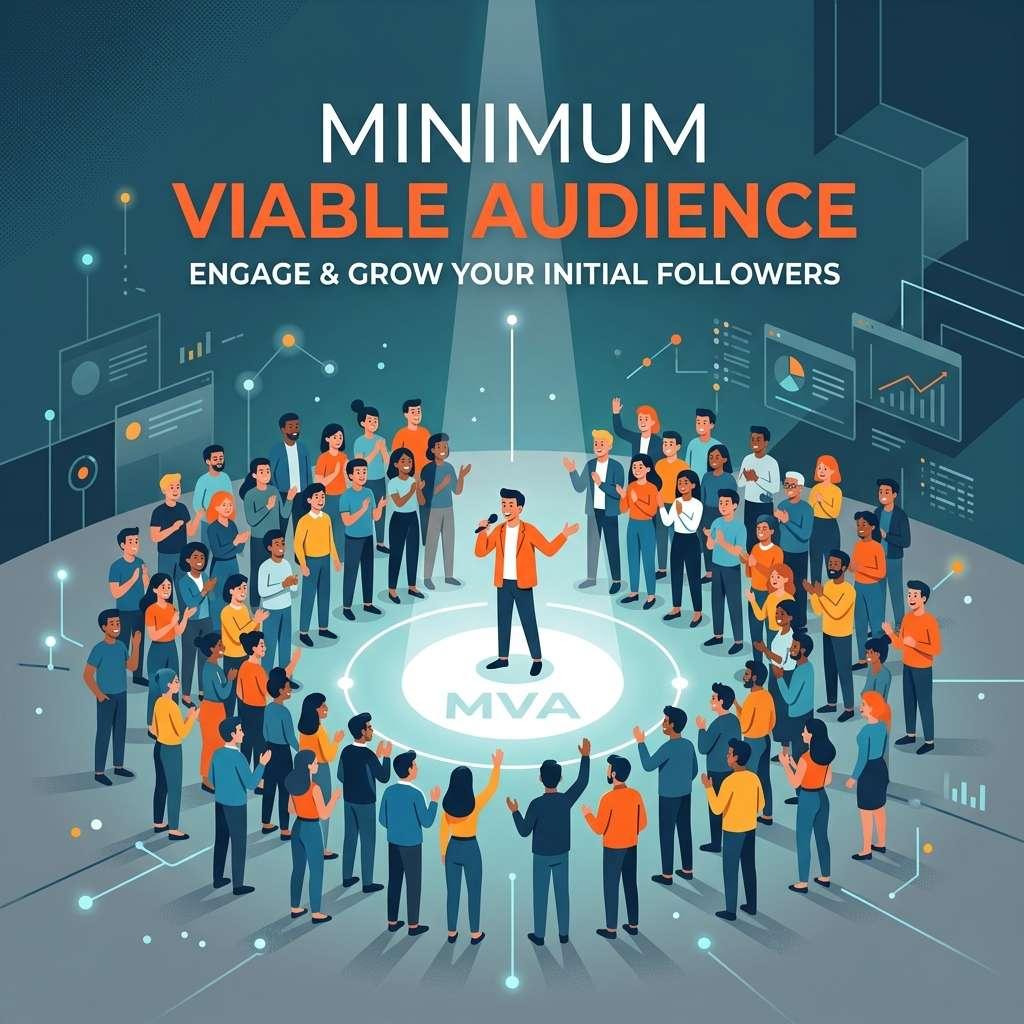
The biggest mistake new creators make isn't choosing the wrong platform; it's building a product before having anyone to sell it to.
You spend months developing an incredible course, writing a comprehensive ebook, or setting up a paid newsletter. You finally hit launch, only to be met with deafening silence. Why? Because you skipped the most crucial step: building a Minimum Viable Audience (MVA).
In the startup world, the concept of a Minimum Viable Product (MVP) is gospel. It means establishing the smallest, most stripped-down version of your product that still delivers value, so you can test it on real users.
For creators, the equivalent is the MVA. Before you ever ask for money, you need an audience just big enough to validate your ideas and provide initial momentum. Here is your roadmap to building one from absolute scratch in 2026.
What is a Minimum Viable Audience?
A Minimum Viable Audience isn't about vanity metrics like "10,000 Twitter followers" or "100k TikTok views". An MVA is measured by engagement and trust, not just reach.
Your target is typically to reach your first 100 to 1,000 true fans. These are people who open your emails, reply to your questions, and actively seek out your perspective. They are small in number, but highly potent in engagement.
The 4-Step Playbook for Building an MVA
Step 1: Define Your "Unfair Advantage" Niche
You cannot be a generalist when starting out. "I write about tech" is too broad. "I write about the business strategies of late-stage SaaS companies" is a niche.
To define your unfair advantage, ask yourself:
- What topics do my peers ask me for advice on?
- What distinct combination of skills or experiences do I possess?
- What specific problem have I personally solved that others are currently struggling with?
Your MVA will be attracted to your specific, differentiated angle.
Step 2: The "Hub and Spoke" Distribution Model
When starting at zero, producing incredible content directly on your own website is necessary, but not sufficient. You must borrow audiences to start. This relies on the Hub and Spoke model.
- The Hub: Your owned platform block. This is where you actually capture and own your audience. A platform like Postion serves as this central headquarters, housing your deeply researched blogs, newsletter signup forms, and future digital products.
- The Spokes: Rented platforms where discovery happens. Think Twitter/X threads, LinkedIn posts, Reddit comments, or YouTube Shorts.
Your objective is to extract attention from the chaotic Spokes and funnel it directly into the quiet, controlled environment of your Hub. You do this by offering high-signal insight natively on social platforms, wrapped with a clear call-to-action back to your Hub.
Step 3: Offer a Ridiculously Valuable "Lead Magnet"
Why would a stranger give you their email address? You have to bribe them with extreme value. This is the Lead Magnet.
Don't resort to generic PDFs like "10 Tips for Better Marketing." Instead, offer something that fundamentally solves a granular problem for your specific niche:
- A meticulously designed Notion template that saves 5 hours a week.
- A spreadsheet of 100 vetted freelance writing clients.
- A 3-day automated email crash course on a complex topic.
Make your lead magnet so good that people feel guilty getting it for free.
Step 4: Engage in "Hand-to-Hand Combat"
Your first 100 subscribers won't come organically. They will be won through intense, one-on-one "hand-to-hand combat."
- Be hyper-active in niche communities: Provide ridiculously detailed answers to questions on Reddit or Discord without immediately dropping a link. Build reputation first.
- Cold DMing: Find people commenting on content similar to yours. Send genuine direct messages offering a relevant, non-spammy insight.
- Guest Posting and Collaborations: If you have 10 subscribers and a fellow creator has 50, collaborate! Cross-pollination is incredibly effective at the MVA stage.
A Simple 90-Day MVA Cadence
If you are overwhelmed, use this operating rhythm for your first three months:
- Week 1 to 4: Publish one flagship piece on your hub each week and turn it into three to five short-form distribution posts.
- Week 5 to 8: Double down on the one channel that produces the most replies, not just the most impressions.
- Week 9 to 12: Refine your lead magnet, actively ask subscribers what they still struggle with, and look for repeated pain points that could become your first paid offer.
This cadence is intentionally simple. The goal is not omnipresence. The goal is to build a repeatable loop of publish, distribute, capture, learn, and refine.
Knowing When You've Reached Your MVA
How do you know when your Minimum Viable Audience is robust enough to launch a paid product or subscription? Look for these signals:
- Consistent Open Rates over 40%: Your emails are actually being read.
- Unprompted Feedback: Subscribers spontaneously reply to your newsletters with thoughts or questions.
- Predictable Acquisition: You know that if you perform X action (e.g., publish a thread), you will consistently gain Y new subscribers.
The Long Game Is Ownership
Building an MVA tests your resilience. It's a slow grind. But the reward is independence.
The critical mistake creators make at the MVA stage is leaving their audience decentralized across social media. An algorithm change can wipe out an MVA built entirely on TikTok in a day.
By utilizing the Hub and Spoke method, your goal is to transition those rented audiences into an owned email list from Day 1. Postion gives you the robust foundation you need to operate that Hub seamlessly, letting you focus on the hard work of earning those first true fans.
Start small, build trust, and never launch a product to an empty room again.
FAQ
Q1: How many subscribers count as a Minimum Viable Audience? A1: There is no single magic number, but many creators see an MVA emerge somewhere between 100 and 1,000 engaged subscribers. The important signal is behavior, not raw list size.
Q2: What should I offer as a lead magnet when I am still small? A2: Offer something narrow, practical, and immediately useful. The best lead magnets solve a specific problem for a specific audience rather than trying to impress everyone with a generic freebie.
Q3: When should I launch a paid offer to my MVA? A3: Launch when the audience consistently opens emails, replies with real questions, and shows repeated interest in one clear problem area. That is usually a stronger signal than waiting for an arbitrary follower milestone.
Topic Hub
Explore the Audience Growth Hub
This article is part of a larger cluster. Use the hub page to move between the pillar guide and the supporting articles that reinforce the same topic.
Keep Exploring
Related Reads
More posts connected to this topic cluster and reading path.
How to Market a Webtoon for Free in 2026 (7 Proven Strategies)
Struggling to get views? Learn how to market your webtoon for free in 2026 with 7 proven strategies, from SEO hacks to community building.
How to Create a Nonprofit Website for Free (A 2026 Guide)
Need to learn how to create a nonprofit website for free? This guide reviews the best free website builders for nonprofits and explains when to invest in a professional platform to build trust and grow your mission.
How to Build a Creator Community (Not Just an Audience)
You have followers, but do you have an online community? Learn the difference between an audience vs community, and get 3 practical community building strategies to foster engagement and build a loyal creator community.