The Guide to Content Creator Platforms: From Digital Renter to Owner

The ecosystem of content creator platforms is characterized by its vastness and complexity. Creators frequently encounter recommendations to establish a presence on platforms such as TikTok, cultivate a following on YouTube, and launch newsletters via services like Substack. While each platform offers distinct advantages, their combined management often results in a chaotic and unsustainable workload.
A strategic re-evaluation of platform engagement is essential. Optimal selection of content creator platforms is not predicated on ubiquitous presence, but rather on a clear understanding of each platform's function and, critically, the establishment of a business foundation that ensures true ownership. This guide systematically clarifies the current landscape and outlines the definitive pathway from digital renter to digital owner within the rapidly evolving creator economy.
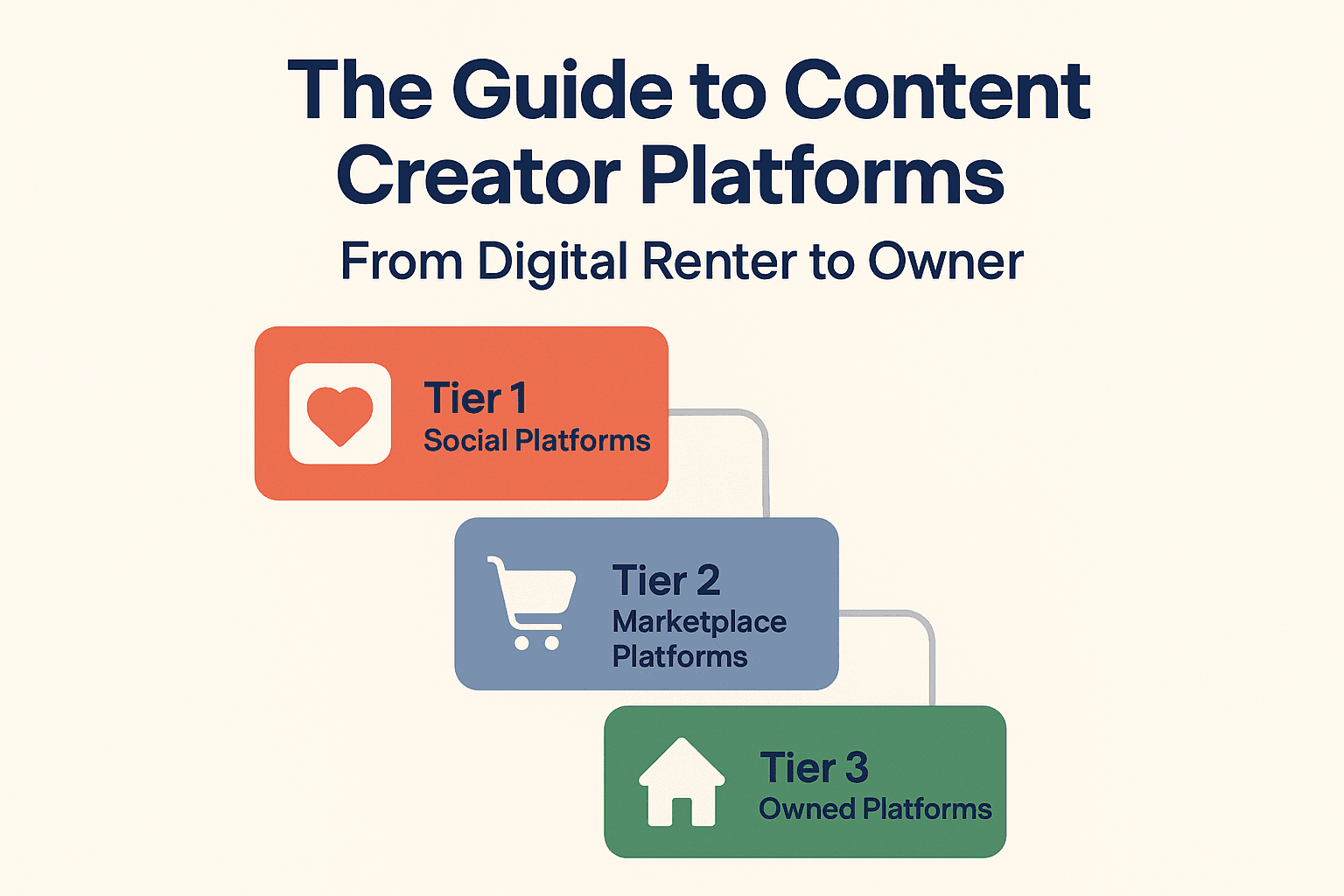
The 3 Tiers of Content Creator Platforms
Content creator platforms are not uniformly structured; they are systematically categorized into three distinct tiers, each defined by a varying degree of creator ownership and control.
Tier 1: Social Platforms (The "Rented Land")
- Definition: Social platforms are digital environments designed for user-generated content sharing and community interaction, characterized by massive, built-in audiences.
- Examples: TikTok, Instagram, YouTube, X (Twitter), Facebook.
- The Promise: These platforms offer unparalleled access to billions of potential viewers and the significant potential for viral discovery, driven by sophisticated recommendation algorithms.
- The Reality: Engagement on social platforms constitutes operating on "rented land." Creators possess zero ownership over their audience data, content distribution, or platform rules. Reach is entirely contingent upon proprietary, often opaque, algorithms. Creators accumulate "followers" rather than direct contact information (e.g., email lists), rendering their audience access vulnerable to sudden algorithmic shifts or policy changes. This inherent lack of control underscores why creator data ownership is so critical for long-term business viability.
Tier 2: Marketplace Platforms (The "Shared Stage")
- Definition: Marketplace platforms are specialized services designed to facilitate direct monetization for creators, often by connecting them with paying subscribers or customers. These are frequently referred to as creator monetization platforms.
- Examples: Substack, Medium, Patreon, Gumroad.
- The Promise: These platforms simplify the process of direct monetization, providing integrated tools for subscriptions, sales, or patronage, thereby lowering the barrier to entry for earning revenue.
- The Reality: While representing an advancement over social platforms, marketplace platforms still do not confer true ownership. Creators operate under the platform's domain and terms of service, meaning their brand identity and audience relationship remain partially controlled by a third party. These platforms commonly impose significant transaction fees, often ranging from 5% to 30% (e.g., Substack's 10% commission), and frequently offer limited customization or advanced tools necessary for sophisticated long-term audience growth and business scaling.
Tier 3: Owned Platforms (The "Headquarters")
- Definition: Owned platforms are digital properties, such as self-hosted websites or dedicated content management systems, where creators maintain 100% control over their content, audience data, branding, and monetization strategies.
- Examples: Postion, a self-hosted WordPress site.
- The Promise: This tier guarantees complete autonomy and ownership over all aspects of a creator's digital presence, content, audience relationships, and revenue streams.
- The Reality: An owned creator platform serves as the foundational digital asset for a sustainable business. It is a lasting investment that appreciates in value over time, providing stability, flexibility, and direct control over the creator's intellectual property and audience engagement.
The Modern Strategy: Your Owned Platform is the Hub
The most effective strategy for contemporary creators involves a synergistic utilization of all three platform tiers. Social and Marketplace platforms are not considered primary residences but rather strategic channels for audience acquisition and initial engagement. This approach is formally known as the Hub and Spoke content model.
Hub and Spoke content model: A content strategy where a central, owned platform (the "hub") serves as the primary repository for long-form, valuable content and audience data, while social and marketplace platforms (the "spokes") are used for content distribution, audience outreach, and directing traffic back to the hub.
Implementation of the Hub and Spoke Model:
- A short, engaging video is published on TikTok, designed to capture initial viewer interest.
- The video incorporates a clear call-to-action, directing viewers to a comprehensive article or resource hosted on the creator's owned platform.
- Upon arrival at the owned platform, visitors are prompted to subscribe to a newsletter, establishing a direct, owned communication channel.
- Through consistent value delivery via the newsletter and owned content, subscribers are systematically nurtured and converted into paying members or customers.
A critical component of this strategy is the principle of "create once, distribute everywhere." This involves producing high-quality, foundational content on the central hub and then repurposing or adapting it for distribution across various spoke platforms to maximize reach and efficiency.
Postion: The All-in-One Owned Platform for Serious Creators
Historically, the implementation of "Owned Platforms" has presented significant technical complexities. While a self-hosted WordPress site offers extensive control, it typically necessitates a considerable investment of time and technical expertise, effectively requiring creators to assume a part-time developer role.
Postion was specifically engineered to mitigate these challenges. It delivers the robust power and comprehensive ownership characteristic of a Tier 3 platform, combined with the intuitive ease of use typically associated with Tier 2 platforms.
Postion is positioned as an optimal platform for content creators seeking to establish a professional digital headquarters without incurring substantial technical overhead.
- True Ownership, Streamlined: Postion simplifies the process of connecting a custom domain and building a high-performance website, ensuring creators retain 100% ownership and control over their digital presence with minimal technical effort.
- A Powerful Growth Engine: Unlike many marketplace platforms, Postion is built upon an SEO-first architecture, providing integrated creator tools designed to attract and sustain an audience organically from search engines. This functionality serves as a cost-effective alternative to hiring expensive SEO services.
- Flexible, Equitable Monetization: As a comprehensive creator platform, Postion supports diverse monetization models, including subscriptions, digital product sales, and memberships, all with transparent and competitive fee structures.
Conclusion: Prioritize Ownership in the Digital Landscape
The value of a creator's content and audience relationships is too significant to be built on foundations lacking full control. Operating solely on third-party platforms effectively positions creators as digital sharecroppers, whose efforts primarily enrich the platform's algorithms and business models.
The strategic imperative for creators is to establish and cultivate their own digital property. While social platforms remain invaluable for initial reach and discovery, the core of a sustainable and scalable creator business must reside on an owned creator platform that guarantees complete control, data ownership, and long-term asset value.
FAQ
Q1: What are the three main types of content creator platforms? A1: Content creator platforms are categorized into three tiers: Social Platforms (e.g., TikTok, YouTube) offering broad reach but no ownership; Marketplace Platforms (e.g., Substack, Patreon) providing monetization tools but limited control; and Owned Platforms (e.g., Postion, self-hosted websites) granting 100% control and ownership.
Q2: Why is an "owned platform" considered the optimal choice for content creators building a business? A2: An owned platform provides creators with complete control over their content, audience data, branding, and monetization strategies. This ensures long-term stability, prevents reliance on third-party algorithms or policy changes, and allows the platform to grow as a valuable, independent digital asset for the creator's business.
Q3: What is the "Hub and Spoke" content model? A3: The Hub and Spoke content model is a strategy where a creator's owned platform (the "hub") serves as the central repository for primary content and audience engagement. Social and marketplace platforms (the "spokes") are then used for content distribution, audience acquisition, and directing traffic back to the owned hub to foster deeper engagement and conversion.