Is Patreon Worth It for Small Creators in 2026?
Is Patreon worth it for small creators in 2026? Learn when Patreon makes sense, when it does not, and how fees, SEO, email ownership, and audience size affect the decision.
TL;DR
- Patreon can be worth it for small creators when speed, simplicity, and community tools matter more than SEO and site ownership.
- The biggest Patreon tradeoff is not just fees but business dependence on a platform-centered environment.
- Small creators with an existing audience often benefit more from Patreon than creators who still need search-based discovery.
- For many creators, the best answer is a hybrid model: website as hub, Patreon as optional monetization layer.
Best for
- Small creators deciding whether to launch on Patreon or build somewhere more owned.
- Writers, podcasters, artists, and educators comparing fast setup with long-term control.
- Creators who want a practical answer instead of a generic "it depends."

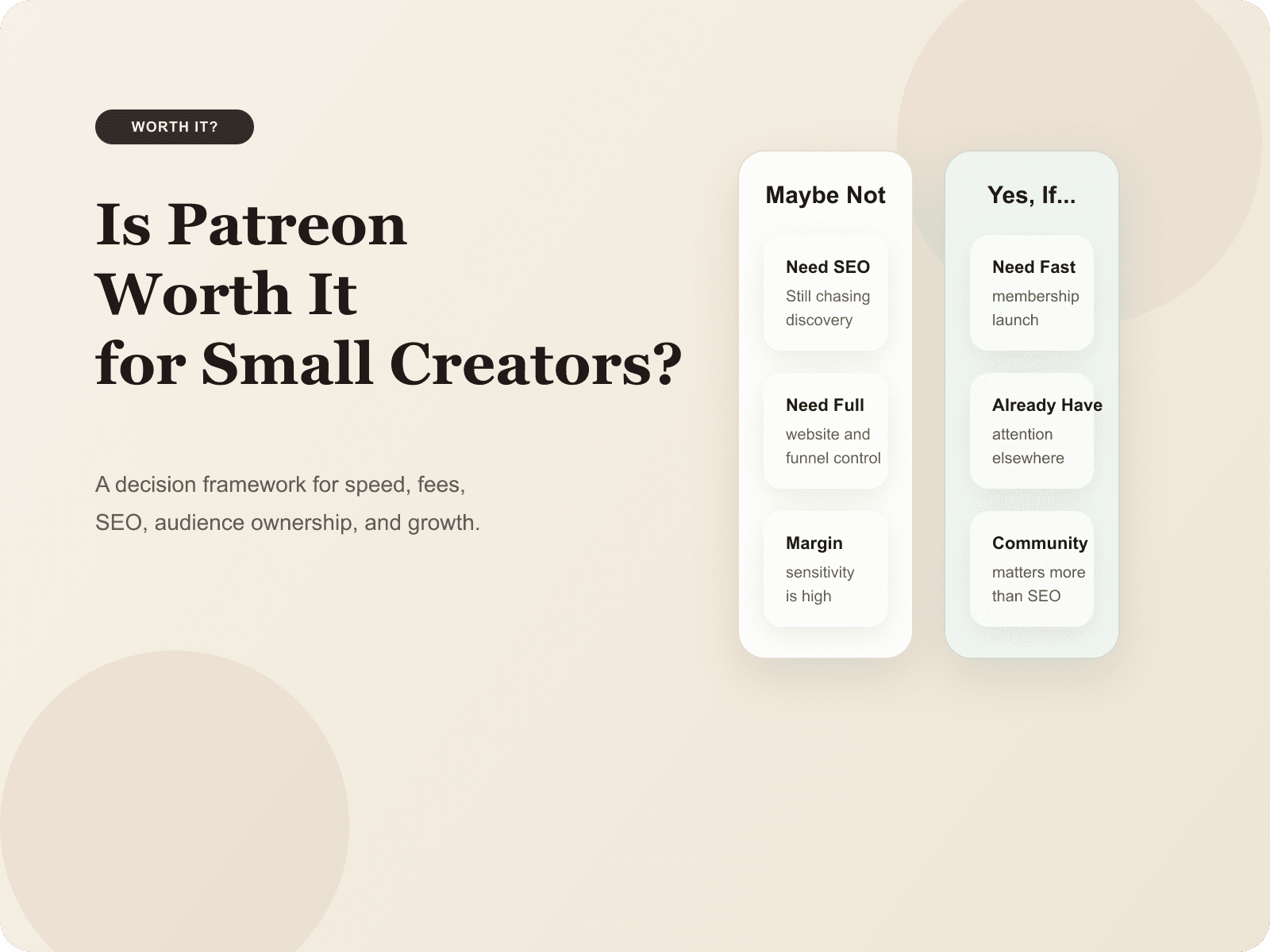
If you are asking is Patreon worth it for small creators, the honest answer is yes for some creators, no for others, and extremely dependent on how you plan to grow.
Patreon is worth it when you want to launch quickly, monetize an audience you already have, and use built-in community tools without much setup. Patreon is less worth it when your strategy depends on SEO, stronger branding, custom site structure, or owning the full customer journey.
So the real question is not just is Patreon worth it. It is: worth it for what kind of creator business?
Is Patreon Worth It? The Short Answer
Patreon is usually worth it if:
- You already have an audience somewhere else
- You want paid memberships live fast
- You care more about community than search traffic
- You are willing to trade some margin for convenience
Patreon is usually less worth it if:
- You are still trying to get discovered
- You want your content to rank on Google
- You want every piece of content to strengthen your own domain
- You want your website to be the center of your business
For many small creators, that distinction decides everything.
Why Patreon Feels So Attractive to Small Creators
Patreon solves the hardest early problem: turning audience trust into revenue without a lot of technical work.
According to Patreon pricing, Patreon is free to start and includes:
- Monthly and annual subscriptions
- Membership tiers
- One-time payments
- Email newsletters
- Community tools like chats, DMs, and comments
- Exportable email lists
- Member analytics and insights
That is a compelling package if you are a small creator who wants to stop waiting for ads, sponsors, or platform bonuses.
In that sense, Patreon can absolutely be worth it. It gives small creators a direct way to get paid now.
When Patreon Is Worth It for Small Creators
1. You already have audience attention somewhere else
If people already follow you on YouTube, TikTok, Instagram, a podcast, or an email list, Patreon can work well as the monetization layer.
It is particularly useful when your discovery happens elsewhere and Patreon is mainly where your biggest fans pay for deeper access.
2. Your offer is community-first
Patreon is at its best when your value comes from:
- Member-only posts
- Community access
- Exclusive behind-the-scenes updates
- Bonus episodes
- Supporter tiers
If your audience wants access, conversation, and consistency more than a polished website experience, Patreon gets a lot stronger.
3. You want speed over system design
For small creators, speed matters.
Sometimes the best move is not to overbuild. It is to launch a simple paid tier, see if anyone buys, and learn from real behavior.
In that scenario, Patreon can be very worth it because it reduces setup friction.
When Patreon Is Not Worth It for Small Creators
1. You still need discovery
This is where many small creators make the wrong call.
Patreon is much better at monetizing an existing audience than growing a new one. If your challenge is still discovery, Patreon is often not the strongest primary platform.
That is why so many creators searching for is Patreon worth it for beginners eventually end up comparing it with a website-first strategy. A website gives you search visibility, internal linking, landing pages, and evergreen content architecture that Patreon does not match as well.
For the full comparison, read Patreon vs Your Own Website: Which Is Better for Creators in 2026?.
2. You care deeply about SEO and domain equity
If every article, guide, and landing page is part of your growth engine, a creator-owned website is usually the better long-term move.
Creators in education, writing, research, coaching, and niche B2B content often fall into this bucket. Their content is not just community material. It is an acquisition asset.
3. You want stronger business control
Patreon’s help center says custom domains are being rolled out gradually and are still limited in availability. Patreon also supports exporting audience emails and is testing email list imports in beta, which is useful.
But even with that progress, Patreon is still a Patreon-centered environment.
An owned website gives you more control over:
- Navigation
- Information architecture
- Lead magnets
- Funnel design
- Multi-offer cross-sells
- The public-to-paid content path
If those things matter a lot to you, Patreon may feel limiting faster than you expect.
Are Patreon Fees Worth It for Small Creators?
Sometimes yes.
Patreon’s official Creator fees overview says many new creators are on the standard 10% platform fee, plus payment processing, payout, currency conversion, and applicable taxes.
That fee stack is not trivial, especially at small price points.
But the right way to think about it is this:
- If Patreon helps you earn your first real revenue, the fees may be worth it.
- If Patreon becomes your long-term home while you sacrifice SEO, branding, and margin, it may become less worth it.
For the exact math, read How Much Does Patreon Take? A Full Creator Fee Breakdown for 2026.
Is Patreon Worth It for Writers, Podcasters, and Artists?
Writers
Patreon is worth it for writers who already have loyal readers and want a simple membership layer.
It is less worth it for writers whose strategy depends on search, evergreen essays, and building topic authority on their own domain.
For the full writer-specific version of this decision, read Patreon for Writers: Is It Worth It in 2026?.
Podcasters
Patreon is often very worth it for podcasters because bonus episodes, supporter feeds, and community perks fit the platform well.
Artists and illustrators
Patreon can work extremely well for artists who monetize behind-the-scenes access, process posts, supporter clubs, and commission priority.
If you are actively comparing options, go next to Patreon Alternatives for Artists: 5 Best Options in 2026.
Educators and niche experts
Patreon can work, but many educators eventually want stronger website structure for SEO, product pages, resources, and course funnels.
Patreon vs a Creator-Owned Website for Small Creators
This is the tradeoff in one sentence:
- Patreon: easier to launch
- Your own website: easier to compound
If your goal is to validate a membership quickly, Patreon may be worth it right now.
If your goal is to build a durable content business that grows from search, products, and owned funnels, a website is usually worth more in the long run.
That is also why Postion vs Patreon: Best Patreon Alternatives for Small Creators in 2026 exists as a separate decision page. It is not just about swapping tools. It is about choosing what kind of business infrastructure you want.
The Best Answer for Many Small Creators
For many creators, the best answer is not "Patreon or website."
It is:
- Build your website as the public hub.
- Use SEO and free content to attract people.
- Capture email subscribers.
- Add Patreon only if you specifically want a membership or community layer there.
That model lets you keep the long-term growth asset while still using Patreon tactically if it helps.
Conclusion
So, is Patreon worth it for small creators in 2026?
Yes, if you want speed, community features, and a fast path to validating paid support.
No, if you expect Patreon to do the job of a search-driven, brand-controlled, creator-owned website.
For many small creators, Patreon is best as a monetization layer, not the entire business foundation.
If you want to keep exploring the decision, read How Much Does Patreon Take? A Full Creator Fee Breakdown for 2026, Patreon vs Your Own Website: Which Is Better for Creators in 2026?, and How to Monetize a Small Audience (Even if You Have Under 1,000 Followers).
Ready to build a more owned creator business? Explore Postion.
FAQ
Q: Is Patreon good for beginners?
A: Patreon can be good for beginners who already have some audience attention and want to launch paid support quickly. It is usually less ideal as the main home for creators who still need discovery.
Q: Is Patreon worth it with a small audience?
A: It can be. A small but engaged audience can absolutely support a Patreon. The key question is whether your immediate need is monetization speed or long-term owned growth.
Q: Should small creators use Patreon or their own website?
A: If you need speed, Patreon may be the easier first step. If you want SEO, stronger branding, and a more durable business asset, your own website is usually the better foundation.
Topic Hub
Explore the Creator Monetization Hub
This article is part of a larger cluster. Use the hub page to move between the pillar guide and the supporting articles that reinforce the same topic.
Keep Exploring
Related Reads
More posts connected to this topic cluster and reading path.
5 Best Content Monetization Platforms Like Patreon in 2026
Looking for the best content monetization platforms like Patreon? Discover top alternatives with better fees, more control, and multiple monetization options.
How to Make Money as a Content Creator Without Brand Deals (7 Sustainable Models)
Learn how to make money as a content creator without brand deals. Discover sustainable creator monetization strategies, Patreon tradeoffs, digital products, memberships, and passive income ideas for 2026.
Patreon vs Your Own Website: Which Is Better for Creators in 2026?
Compare Patreon vs your own website for creator monetization in 2026. Learn the tradeoffs in fees, SEO, branding, audience ownership, email, and long-term growth before you choose.