How to Make Money as a Content Creator Without Brand Deals (7 Sustainable Models)
Learn how to make money as a content creator without brand deals. Discover sustainable creator monetization strategies, Patreon tradeoffs, digital products, memberships, and passive income ideas for 2026.
TL;DR
- The fastest answer to how to make money as a content creator is not "wait for sponsors" but "sell a clear offer to a specific audience."
- Small creators usually monetize earlier with services, templates, workshops, and memberships than with ads or large brand campaigns.
- Patreon can be useful for community-first creators, but an owned platform is often better for SEO, branding, and long-term audience control.
- The strongest creator businesses stack one-time revenue, recurring revenue, and evergreen traffic instead of depending on a single channel.
Best for
- Creators who want to make money without waiting for brand deals or massive follower counts.
- Writers, educators, artists, and niche experts deciding what to sell first.
- Anyone comparing Patreon with a more owned, SEO-friendly creator business model.

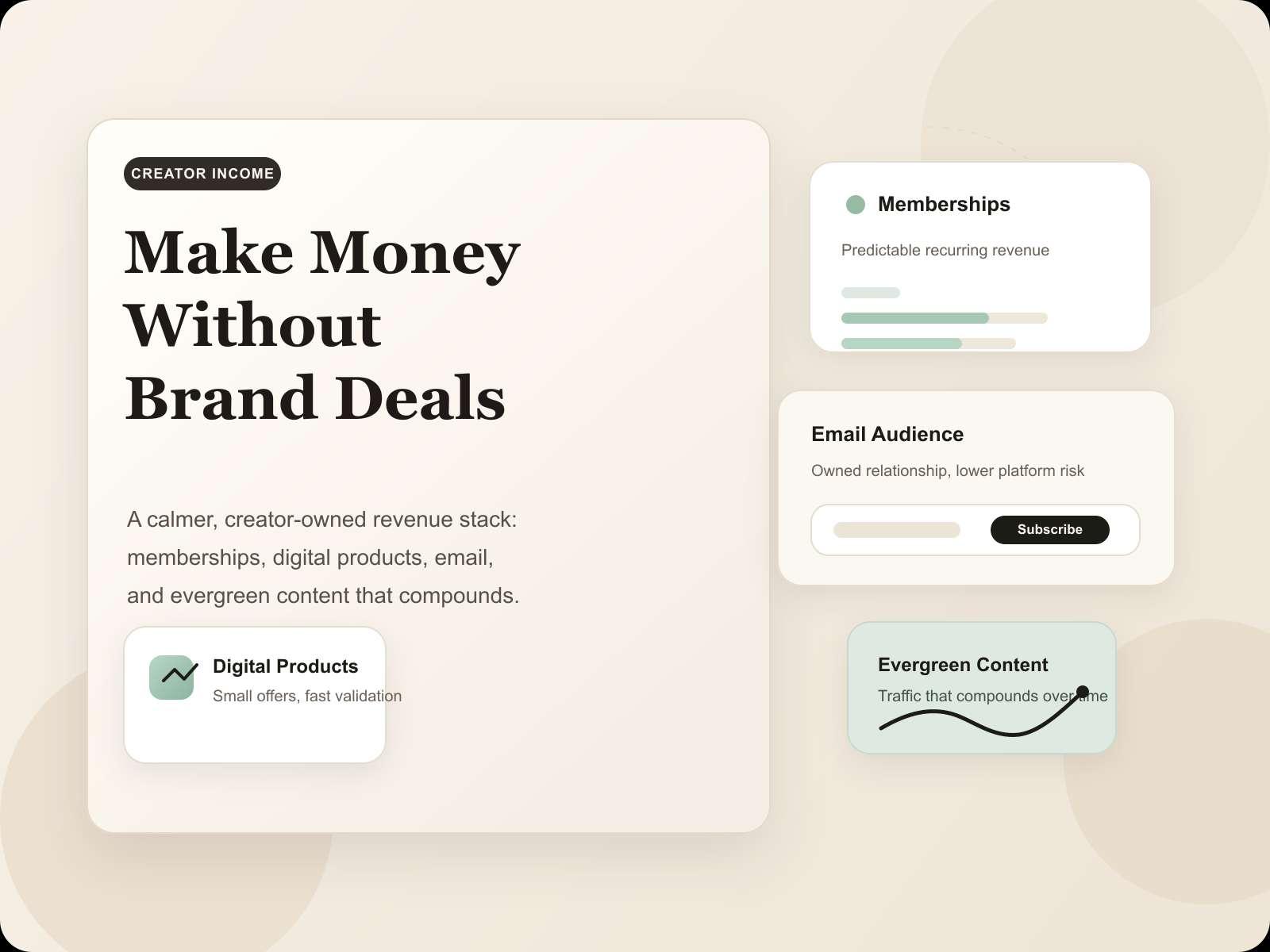
If you are asking how to make money as a content creator, the worst strategy is waiting for brand deals to magically appear. The better question is: how do you make money as a content creator without brand deals, without depending only on ads, and without needing a massive audience first? In 2026, the most resilient creator businesses make money through owned offers, recurring memberships, digital products, and evergreen content that compounds over time.
That shift matters because a sponsorship-first business is fragile. Budgets change, algorithms shift, and a great month can be followed by two quiet ones. If you want a more durable playbook, start with creator monetization models you control.
For the big-picture framework, start with The Ultimate Guide to Creator Monetization in 2026 (Beyond Ads). Then use this guide to decide what to sell first.
Why "How to Make Money as a Content Creator" Is Really a Business Model Question
Most creators do not have an audience problem. They have an offer problem.
They publish consistently, get some attention, maybe even build a few thousand followers, and still struggle to turn that attention into revenue. That usually happens because their business model depends on someone else saying yes:
- A sponsor needs to approve the campaign.
- A platform needs to keep paying ad revenue.
- An algorithm needs to keep distributing the content.
If you want to learn how to make money as a content creator with a small audience, the answer is usually to sell something direct:
- A template
- A workshop
- A premium subscription
- A paid community
- A service tied to your expertise
That is exactly why How to Monetize a Small Audience (Even if You Have Under 1,000 Followers) is such an important starting point. A small, trusted audience often monetizes faster than a large, distracted one.
1. Sell a Small Digital Product First
For many creators, the easiest first answer to how to make money as a content creator is a small digital product with a clear outcome.
Instead of building a giant course immediately, sell something lightweight:
- A Notion template
- A swipe file
- A mini-guide
- A niche toolkit
- A recorded workshop
This works because buyers do not need to make a huge leap of trust. A $19 to $79 product is often much easier to validate than a $499 course.
If you want the full playbook, see How to Sell Digital Products Online? (2026 Ultimate Guide). It pairs especially well with long-tail searches like digital products for content creators and how to sell digital products as a content creator.
What makes a digital product convert?
The best digital product is not the most complicated one. It is the one that solves an expensive, annoying, or urgent problem quickly.
Good examples:
- A creator finance spreadsheet for freelancers
- A content calendar system for newsletter writers
- A client onboarding template for UGC creators
- A lesson plan bundle for educators
If your audience keeps asking the same question, that question is often the product.
2. Add Recurring Revenue with Memberships or Paid Newsletters
If one-time product sales create bursts of income, memberships create stability.
This is where many creators shift from occasional income to a real business. Instead of selling only once, you build a reason for people to stay:
- Weekly premium posts
- Members-only tutorials
- Private community access
- Monthly office hours
- Exclusive archives or downloads
Creators searching for how to monetize content without ads usually end up here because memberships replace unstable ad revenue with predictable monthly revenue. Our guide How to Monetize Content Without Ads? (5 Proven Strategies) breaks down the wider strategy, and Best Membership Site Platforms for Creators (5 Essential Tips) shows what to look for in the platform layer.
A strong membership offer is not "more content"
The best memberships are built around one of three promises:
- Save me time.
- Help me improve faster.
- Give me access I cannot get elsewhere.
If your paid tier only says "support my work," conversion will usually stay low. If it says "get my weekly teardown, monthly templates, and a private strategy Q&A," the value is much clearer.
3. Use Services to Fund the Rest of Your Creator Business
One of the most underrated answers to how to make money as a content creator with a small audience is selling a service first.
This is especially effective if you are:
- A designer
- A strategist
- A writer
- A coach
- A niche educator
Services are not infinitely scalable, but they are fast. They generate cash flow while you build slower-moving assets like products, memberships, and search traffic.
Examples:
- A 60-minute consulting call
- A channel audit
- A portfolio review
- A monetization strategy session
- A done-for-you setup package
The smart version of this model is not staying in services forever. It is using services to learn what your audience will pay for, then turning that insight into a productized offer.
4. Build Passive Income for Content Creators with Evergreen Assets
The phrase passive income for content creators gets overused, but the underlying idea is still solid: create assets once, then let them keep selling.
That usually looks like:
- Search-driven blog posts
- Evergreen YouTube tutorials
- Template libraries
- Mini-courses
- Automated email funnels
- Resource pages with affiliate links
The key is that passive income is rarely passive at the start. It becomes passive after you build the content, connect it to the right offer, and keep the system alive long enough to compound.
How to Build Passive Income as a Content Creator (7 Proven Strategies) goes deeper on this model, but the short version is simple: your free content should not just collect views; it should move readers toward an email list, a product, or a membership.
5. Monetize Content Without Ads by Stacking Offers
Many creators think they need to pick one model forever. They do not.
The strongest content monetization systems are stacked:
- Free content brings discovery
- Email captures attention
- A low-ticket product generates first purchases
- A membership creates recurring revenue
- A premium service captures high-intent buyers
That stack is much more stable than relying on a single revenue stream.
If you only use ads, your income is volatile. If you only use services, your time becomes the bottleneck. If you only use memberships, growth can feel slow. But when you combine them, each layer supports the others.
This is also why 7 Ways to Diversify Your Creator Income Streams in 2026 (Beyond Brand Deals) is worth reading alongside this guide.
6. Patreon vs Owning Your Platform: What Creators Should Know
If you are comparing options, Patreon will probably come up early, and that makes sense. According to Patreon pricing, Patreon is free to start and positions itself around memberships, one-time payments, newsletters, community tools, and creator discovery. For some creators, that is genuinely useful.
But the tradeoff matters. Patreon’s official Creator fees overview, updated March 17, 2026, says creators who published after August 4, 2025 are on the standard 10% platform plan, plus payment processing, payout, currency conversion, and applicable tax-related fees. That does not make Patreon bad, but it does mean the all-in cost can matter more than people expect.
When Patreon makes sense
Patreon is a strong fit if you want:
- Fast setup
- Community-first membership tools
- A familiar platform for fans
- Podcast or art support workflows
When an owned platform is better
An owned platform is usually better if your strategy depends on:
- SEO and organic search traffic
- A custom domain
- Better brand control
- Lower fee sensitivity
- Turning blog content into a monetization funnel
That is why many creators who start on Patreon later look for a more independent setup. If you want the detailed comparison, read Postion vs Patreon: Best Patreon Alternatives for Small Creators in 2026.
7. Choose the Right Monetization Model for Your Audience Size
The right answer to how to make money as a content creator changes depending on what stage you are in.
If you have 0 to 500 engaged followers
Start with:
- One service
- One lead magnet
- One small digital product
Your goal is proof of willingness to pay, not complexity.
If you have 500 to 2,000 engaged followers
Add:
- A paid workshop
- A premium newsletter
- A lightweight membership
This is often the sweet spot for how to make money as a content creator with a small audience because trust is already forming.
If you have 2,000+ engaged followers
Now you can layer:
- Sponsorships
- Recurring memberships
- Evergreen digital products
- Selective affiliate offers
- Higher-ticket coaching or consulting
At this stage, brand deals can become a bonus, but they should not be the foundation.
A Simple Creator Monetization Stack for 2026
If you want a practical answer, here is a clean default stack:
- Publish free educational content that ranks or gets shared.
- Capture email subscribers with a focused freebie.
- Sell one small digital product.
- Launch one recurring membership or paid newsletter.
- Add a premium service for your highest-intent buyers.
That path is smoother, more controllable, and usually more profitable than waiting for sponsorships.
Conclusion
The real secret behind how to make money as a content creator is not going viral. It is building a monetization system that still works when the algorithm cools down.
Start with the simplest offer your audience already wants. Then turn your best ideas into products, your best readers into subscribers, and your best content into evergreen traffic. That is how you build a creator business that lasts.
If you want to go deeper, read How to Monetize Content Without Ads? (5 Proven Strategies), How to Build Passive Income as a Content Creator (7 Proven Strategies), and The Ultimate Guide to Creator Monetization in 2026 (Beyond Ads).
FAQ
Q: Do I need brand deals to make money as a content creator?
A: No. Many creators earn earlier through digital products, memberships, consulting, workshops, and affiliate content. Brand deals can help later, but they are not required to start.
Q: Is Patreon worth it for small creators in 2026?
A: It can be, especially if you want a quick membership setup and community features. But if SEO, branding, and fee control matter more, an owned platform may be the better long-term option.
Q: What is the best first product for a creator?
A: Usually the best first product is a small, specific offer that solves one immediate problem. Templates, mini-guides, audits, and workshops are often easier to validate than a large course.
Topic Hub
Explore the Creator Monetization Hub
This article is part of a larger cluster. Use the hub page to move between the pillar guide and the supporting articles that reinforce the same topic.
Keep Exploring
Related Reads
More posts connected to this topic cluster and reading path.
5 Best Content Monetization Platforms Like Patreon in 2026
Looking for the best content monetization platforms like Patreon? Discover top alternatives with better fees, more control, and multiple monetization options.
Is Patreon Worth It for Small Creators in 2026?
Is Patreon worth it for small creators in 2026? Learn when Patreon makes sense, when it does not, and how fees, SEO, email ownership, and audience size affect the decision.
Patreon vs Your Own Website: Which Is Better for Creators in 2026?
Compare Patreon vs your own website for creator monetization in 2026. Learn the tradeoffs in fees, SEO, branding, audience ownership, email, and long-term growth before you choose.