Patreon vs Your Own Website: Which Is Better for Creators in 2026?
Compare Patreon vs your own website for creator monetization in 2026. Learn the tradeoffs in fees, SEO, branding, audience ownership, email, and long-term growth before you choose.
TL;DR
- Patreon is usually faster to launch, but your own website usually wins on SEO, branding, and long-term control.
- Patreon’s official standard pricing for new creators is 10% plus other fees, which changes the math as your revenue grows.
- A creator website is more work upfront, but it gives you a stronger content funnel and a more durable business asset.
- The best long-term setup for many creators is a hub-and-spoke model where your website is the hub and Patreon is optional.
Best for
- Creators deciding between a fast Patreon launch and a more owned website strategy.
- Writers, podcasters, educators, and niche experts comparing recurring membership models.
- Small creators who want to understand whether Patreon is enough or just a starting point.

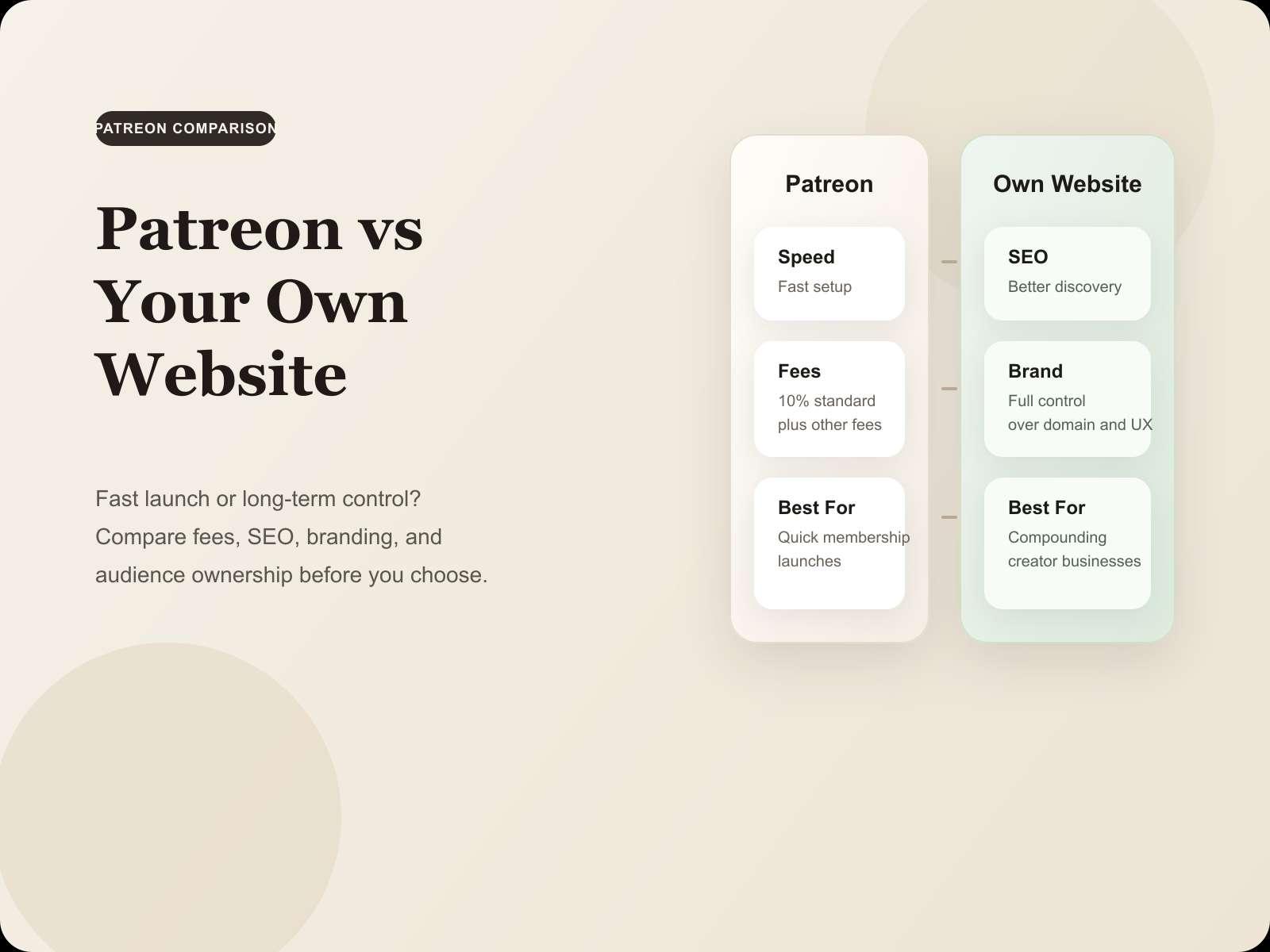
If you are comparing Patreon vs your own website, you are really choosing between speed and control. Patreon is fast to launch, easy to understand, and built around memberships. Your own website takes more setup, but it usually gives you stronger SEO, better branding, more control over the customer journey, and a more durable creator business over time.
That is why Patreon vs your own website is not just a platform comparison. It is a business model decision.
If you want the direct product comparison after reading this page, also see Postion vs Patreon: Best Patreon Alternatives for Small Creators in 2026. If your decision is mostly about fees, read How Much Does Patreon Take? A Full Creator Fee Breakdown for 2026. But first, here is the bigger strategic question: should your business live inside Patreon, or should Patreon be just one tool in a creator-owned stack?
Patreon vs Your Own Website: The Short Answer
For most creators, Patreon is better when you need to launch quickly and validate whether people will pay.
Your own website is better when you want to:
- Rank on Google
- Build a branded content library
- Control the full reader-to-customer journey
- Reduce platform dependency over time
- Turn content into a long-term asset
If you are still early, Patreon can absolutely work. But if you are building for the next three to five years, an owned website usually becomes the stronger home base.
Patreon vs Personal Website: Head-to-Head Comparison
| Category | Patreon | Your Own Website |
|---|---|---|
| Launch speed | Very fast | Slower setup |
| Platform fee | Standard 10% for many new creators, plus other fees | Depends on your stack, often lower platform dependency |
| SEO potential | Limited compared with a full website | Stronger long-term organic search upside |
| Branding | Patreon-led environment | Full control over design and positioning |
| Content structure | Membership-first | Blog, landing pages, archives, docs, products, memberships |
| Email relationship | Exportable email lists, but Patreon-centered experience | Full funnel control and list architecture |
| Community tools | Strong built-in community features | Depends on your setup |
| Custom domain | Rolling out gradually in early access | Standard expectation |
| Business durability | Better than social-only, but still platform-dependent | Best long-term ownership model |
Where Patreon Wins
To be fair, Patreon solves a lot of real problems well.
According to Patreon pricing, Patreon is free to start and supports monthly and annual subscriptions, membership tiers, one-time payments, community tools, email newsletters, analytics, and podcast support. If your main job today is getting a membership offer live quickly, that is compelling.
Patreon is especially strong for creators who want:
- A simple way to launch paid memberships
- Native community features like chats, comments, and DMs
- Minimal operational setup
- Podcast-friendly workflows
- A familiar payment experience for fans
For creators who have been relying on brands or ad revenue, Patreon can be a meaningful upgrade. It creates a direct revenue stream instead of forcing you to wait for sponsors. That is one reason our guide on How to Make Money as a Content Creator Without Brand Deals (7 Sustainable Models) recommends memberships as one of the first direct monetization layers.
Where Your Own Website Wins
An owned website usually wins when your strategy depends on discovery, positioning, and compounding traffic.
This is the core difference:
- Patreon is optimized for monetizing the audience you already have.
- Your own website is better at monetizing and growing the audience over time.
With a website, you can publish:
- Search-optimized blog posts
- Pillar guides
- Product landing pages
- Email signup funnels
- Comparison pages
- Evergreen resource hubs
That matters because creators rarely grow from one offer alone. They grow from systems. A strong site lets free content lead into email, products, memberships, and higher-ticket offers. That is much harder to build elegantly inside a Patreon-first setup.
If you want the strategic framing for this, read The Guide to Content Creator Platforms: From Digital Renter to Owner. It explains why owned platforms function best as your headquarters.
Patreon Fees vs Website Economics
This is one of the biggest decision points in the Patreon vs your own website debate.
Patreon’s official Creator fees overview says that creators who publish after August 4, 2025 are on the standard 10% plan, plus payment processing, payout, currency conversion, and applicable tax-related fees. Existing legacy creators may still be on older plans, but new creators need to evaluate the current default economics.
That does not automatically mean Patreon is too expensive. In the early stage, paying more for speed and convenience can be rational.
But the economics change as you grow:
- At low revenue, convenience matters more.
- At meaningful recurring revenue, fee drag matters a lot more.
That is why many creators start on Patreon, prove demand, and then move toward a more owned setup later. If your revenue is compounding, the platform decision becomes a margin decision too.
Patreon vs Website for SEO and Discovery
If your growth plan includes search, Patreon vs website for SEO is not a close fight.
A website is better because it gives you:
- Search-indexable long-form content
- Better control over titles, descriptions, and information architecture
- Internal linking across articles and offers
- Topic clusters and comparison pages
- Stronger authority building over time
Patreon can help you monetize existing fans, but it is not designed to be your main SEO engine. That is why creators who care about search usually need a public content layer outside Patreon.
For example, if you are building around creator-business topics, a public article like How to Monetize Content Without Ads? (5 Proven Strategies) can attract new readers, while a paid product or membership captures the value later. Your website connects those stages much more naturally.
Patreon vs Your Own Website for Branding and Domain Control
Brand control is another meaningful separator.
Patreon’s help center says custom domains are being rolled out gradually and, at the time of that article, were only available to creators in its early access program. That is better than having no option at all, but it is still not the same thing as building on a website where domain ownership and site architecture are standard from day one.
An owned website gives you stronger control over:
- The visual experience
- Navigation
- The path from free content to paid offers
- The relationship between your brand and your domain
If domain-level authority matters to you, why custom domains matter for SEO is worth reading next.
Patreon and Email Ownership: Better Than Social, Still Not the Same as a Website
This part is subtle.
Patreon is stronger than social media because it does support more direct audience relationships. Patreon’s pricing page highlights exportable email lists, and Patreon’s help center documents how creators can export audience emails. Patreon is also testing email list imports in beta.
That is real progress, and it is important to say that clearly.
But an owned website still gives you more control over:
- Signup flow
- Lead magnets
- Multi-step funnels
- Public vs private content architecture
- Cross-sells between products, memberships, and services
So if your question is "Can I build an audience relationship on Patreon?" the answer is yes.
If your question is "Does Patreon give me the same long-term funnel control as my own website?" the answer is still no.
When Patreon Is the Right Choice
Choose Patreon first if:
- You want to validate willingness to pay quickly
- Your audience already follows you elsewhere
- Community and member interaction matter more than SEO
- You want the simplest possible membership launch
- You are okay with platform convenience costing more over time
This is especially true for creators whose audiences are primarily audio, video, or community driven.
When Your Own Website Is the Right Choice
Choose your own website first if:
- Your strategy depends on search traffic
- You want content to compound for years
- You want stronger brand identity
- You plan to sell multiple offer types
- You want your website to be the center of your business
This is often the better route for writers, educators, researchers, and niche experts who want every article to strengthen the entire business.
If you are specifically evaluating this from a writing-business angle, read Patreon for Writers: Is It Worth It in 2026?.
If that sounds like you, What is Postion? The All-in-One Creator Platform (A Substack & Ghost Alternative) is the best next read.
The Smart Hybrid: Website as Hub, Patreon as Optional Layer
For many creators, the best answer is not Patreon or website. It is website first, Patreon optional.
Use your website as the hub for:
- SEO
- Email capture
- Brand authority
- Product pages
- Public education content
Then use Patreon only if you specifically want:
- A membership community layer
- A lighter-weight fan support product
- A fast experimental tier
This hybrid model keeps your core business asset under your control while still letting you use Patreon tactically if it adds value.
Conclusion
The best way to think about Patreon vs your own website is this: Patreon is a monetization tool, while your website can become the operating system for your creator business.
If you need speed, Patreon is strong.
If you need a long-term business asset that ranks, converts, and compounds, your own website is usually the better foundation.
The strongest creators often start simple, then move toward ownership as soon as the business justifies it.
If you want to keep exploring, read How Much Does Patreon Take? A Full Creator Fee Breakdown for 2026, Is Patreon Worth It for Small Creators in 2026?, Postion vs Patreon: Best Patreon Alternatives for Small Creators in 2026, and Best Membership Site Platforms for Creators (5 Essential Tips).
FAQ
Q: Is Patreon better than having your own website?
A: Patreon is better for speed and simplicity. Your own website is usually better for SEO, branding, funnel control, and long-term ownership.
Q: Can I use Patreon and my own website together?
A: Yes. In many cases that is the smartest model. Use your website as the public hub and Patreon only for the specific community or membership layer it handles well.
Q: Does Patreon let creators export email lists?
A: Yes. Patreon’s official materials say creators can export audience emails, but that still does not give you the same level of funnel and site control as running your own website.
Topic Hub
Explore the Creator Monetization Hub
This article is part of a larger cluster. Use the hub page to move between the pillar guide and the supporting articles that reinforce the same topic.
Keep Exploring
Related Reads
More posts connected to this topic cluster and reading path.
5 Best Content Monetization Platforms Like Patreon in 2026
Looking for the best content monetization platforms like Patreon? Discover top alternatives with better fees, more control, and multiple monetization options.
How to Make Money as a Content Creator Without Brand Deals (7 Sustainable Models)
Learn how to make money as a content creator without brand deals. Discover sustainable creator monetization strategies, Patreon tradeoffs, digital products, memberships, and passive income ideas for 2026.
Is Patreon Worth It for Small Creators in 2026?
Is Patreon worth it for small creators in 2026? Learn when Patreon makes sense, when it does not, and how fees, SEO, email ownership, and audience size affect the decision.