Patreon Tier Ideas: 30 Benefits and Example Tiers for 2026
Need Patreon tier ideas? Get 30 easy-to-deliver benefits, example tiers for artists, writers and podcasters, tier names, and pricing with real fee math.
TL;DR
- Most creators should start with one to three Patreon tiers, and only offer benefits they can keep delivering on a bad week.
- The cheapest tiers lose the largest share to fees. For a new creator on Patreon, about 18% to 19% of a $3 or $5 pledge goes to fees, compared with about 14% of a $25 pledge.
- In an example of 100 members split across $5, $10 and $25 tiers, the 10 members on the top tier bring in about 29% of gross revenue.
- Benefits that give members access or recognition usually cost less time than producing extra content every month.
Best for
- Creators setting up Patreon tiers for the first time.
- Existing Patreon creators whose benefits have become too much work to deliver.
- Artists, writers, podcasters and video creators looking for tier examples they can adapt.

Good Patreon tier ideas have one thing in common: you can still deliver them during your worst month. Most tiers fail because the creator promises too much, not because the benefits aren't exciting. A monthly video, a personal thank-you and a custom sketch might sound great at launch, but they become a second job as soon as you have 50 members.
This guide gives you 30 Patreon benefit ideas sorted by type, example tiers for different kinds of creators, tier names, and a look at how fees change your pricing. If you're still deciding whether the platform is right for you, start with is Patreon worth it for small creators.
How Many Patreon Tiers Should You Have?
Start with one to three tiers. That's in line with Patreon's own advice for setting up tiers, which also favors benefits you can repeat, batch and schedule. You can always add a tier later, but removing a benefit from people who are already paying for it is awkward.
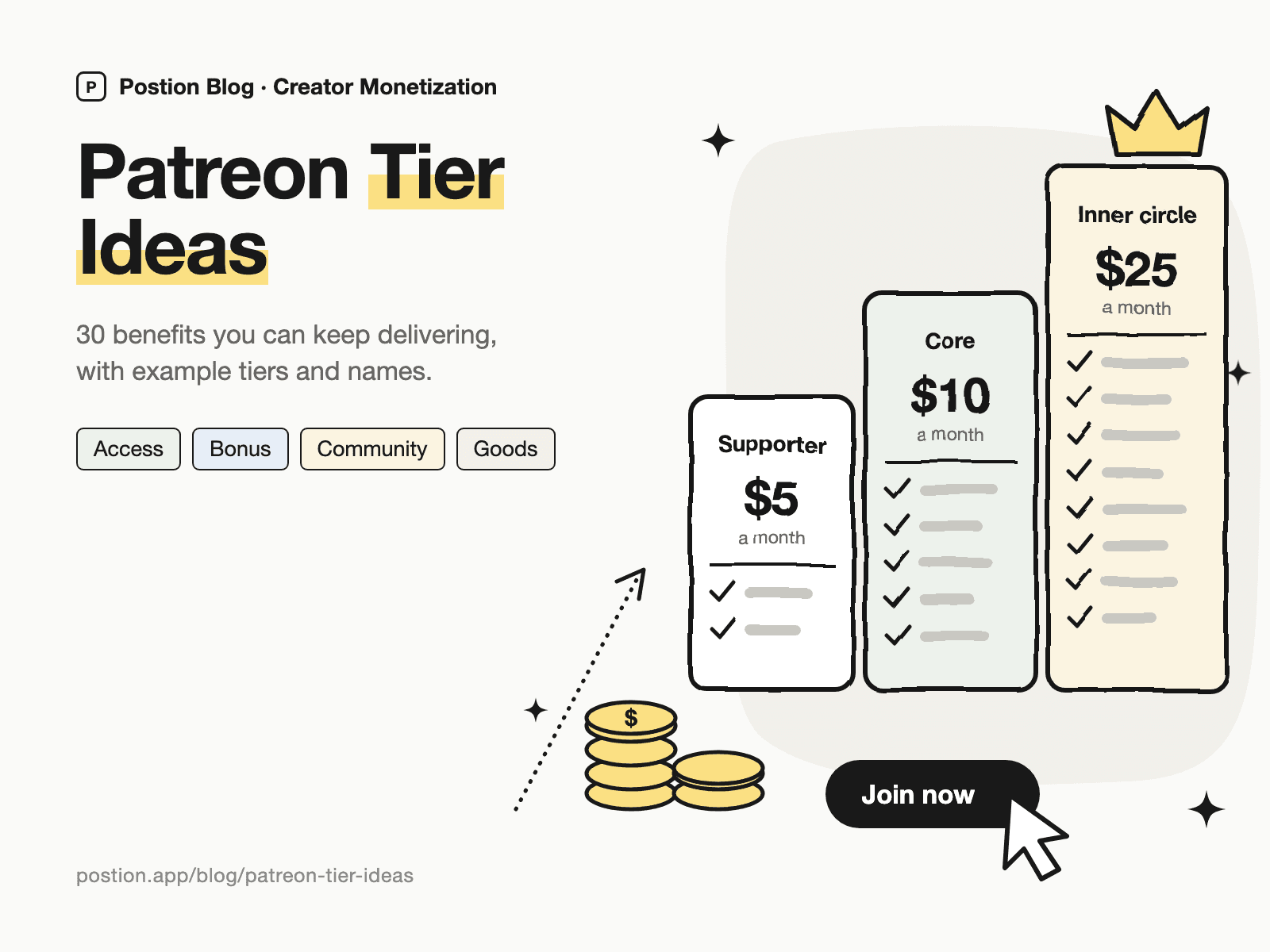
Three is a good default if you have the time to serve it, because it gives people a clear choice:
| Tier | Starting price | Job it does | What it should include |
|---|---|---|---|
| Supporter | $3–$5 | Makes it easy to say yes | A thank-you, early access or a members' feed |
| Core | $8–$15 | Where most members should land | Bonus content on a set schedule |
| Inner circle | $25–$50+ | Serves your biggest fans | Access to you, such as Q&As or feedback, with limited spots |
These prices are starting points rather than rules, and your niche matters. An audience of working professionals will usually accept higher prices than a general fan community. For more on anchoring and benchmarks, read our guide on how to price a membership community.
30 Patreon Tier Ideas That Are Easy to Deliver
Each idea below is marked by the time it usually takes to run: low, medium or high. The best Patreon tier ideas combine mostly low-effort benefits with one main benefit you enjoy making.
Early access and behind-the-scenes
- Early access to public work (low). Members see each post or episode a few days before everyone else. It costs nothing extra to make.
- Works in progress (low). Share sketches, rough cuts and drafts you're already creating.
- Monthly creator update (low). A short post on what you're working on and what's coming next.
- Process notes (low). Explain a decision behind one recent piece of work.
- Bloopers and cut material (low). Put work that didn't make the final version to good use.
- Your tools and setup list (low). Publish it once and update it now and then.
Bonus content
- A members' feed (medium). A regular post that's only available to paying members.
- Extended cuts (low to medium). Longer versions of what you already publish, which suit podcasts especially well.
- Ad-free versions (low). Often a simple extra export of existing work.
- Back catalog access (low). Open up your archive to members and keep adding to it.
- Monthly deep dive (high). One big piece that's worth paying for on its own.
- Members-only series (high). A short recurring series that gives people a reason to stay subscribed.
Recognition
- Name in the credits (low). A line at the end of a video, episode or post.
- Shout-outs (low). Thank new members in a batch, once a month.
- A supporter wall (low). A public page listing your members' names.
- Member badges or Discord roles (low). Patreon can connect tiers to Discord roles, so there's little to manage once it's set up.
- Input into the work (low). Name a character, or include a member's question in an episode.
Community and voting
- Polls on what you make next (low). Members get a say, and you get free market research.
- Private Discord or group chat (medium). It builds a strong sense of belonging, but only if it's moderated and active. An empty chat is worse than none.
- Live hangouts (medium). One monthly session, with the recording posted for anyone who misses it.
- Watch or read-along events (medium). A shared activity that fits fan communities and book clubs.
- Member spotlights (low). Feature a member's work or story, with their permission.
Learning and feedback
- Monthly Q&A (medium). Collect questions in advance and answer them in one recording.
- Tutorials and how-tos (medium). Teach the method behind your work.
- Group critique (medium). Review a few submissions in one session, so everyone learns from the feedback.
- Limited one-on-one feedback (high). Offer it at your top tier with a cap on members, and it stays manageable.
Digital and physical goods
- Monthly downloads (medium). Wallpapers, brushes, templates, stems or printables. If you're building more of these, see our list of digital products to sell.
- Discounts on your products (low). A member code for your shop rewards loyalty without extra production.
- Source files (low). Project files, PSDs or outlines you already have.
- Merch or physical rewards (high). Popular but risky, because production, shipping and returns all take time and eat into margin. Save this for later, or offer it once a year.
Patreon Tier Examples by Creator Type
Adapt these Patreon tier ideas to your work rather than copying them outright.
| Creator | Supporter ($3–$5) | Core ($8–$15) | Inner circle ($25+) |
|---|---|---|---|
| Artist or illustrator | Works in progress, early access | Monthly downloads, brushes, process videos | Monthly critique for a limited group |
| Writer | Early chapters, a thank-you page | Bonus stories or essays, full archive | Manuscript feedback or a monthly writing session |
| Podcaster | Ad-free episodes, early release | Bonus episodes, a members' Discord | Monthly live recording and Q&A |
| Video creator | Early access, name in the credits | Extended cuts, behind-the-scenes videos | Monthly hangout, input on future videos |
| Educator or coach | Resource library | Monthly tutorial and templates | Group coaching call |
Writers can find more detail in our guide to Patreon for writers, and podcasters can see where memberships fit in how to monetize a podcast. Artists comparing support platforms should also read Ko-fi vs Patreon for artists.
Patreon Tier Names That Fit Your Brand
Your tier name won't sell the benefit, but it can make joining feel like part of something. The rule is simple: be clever if you like, but make sure the price and benefits are obvious at a glance.
- Plain and clear: Supporter, Member, Patron
- Writers and publishers: Reader, Subscriber, Editor's Circle
- Artists: Sketchbook, Studio Pass, Collector
- Podcasters and radio: Listener, Backstage, Producer
- Games and fantasy: Apprentice, Adventurer, Guild Master
- Food and drink: Coffee, Regular, Chef's Table
How to Price Patreon Tiers After Fees
Fees take a larger share of low-priced tiers, because part of the processing cost is a fixed amount per payment. Here's what a new creator on Patreon's standard plan keeps from one payment in the US:
| Monthly price | Platform fee (10%) | Processing | You keep | Share lost to fees |
|---|---|---|---|---|
| $3 | $0.30 | $0.25 | $2.45 | About 18% |
| $5 | $0.50 | $0.45 | $4.05 | About 19% |
| $10 | $1.00 | $0.59 | $8.41 | About 16% |
| $25 | $2.50 | $1.03 | $21.47 | About 14% |
Based on a 10% platform fee for creators who joined after August 4, 2025, 5% + $0.10 processing on payments of $3 or less, and 2.9% + $0.30 above that. Payout fees and tax aren't included, and rates vary by country and currency. Compare other platforms in our creator fee calculator or read the full breakdown of how much Patreon takes.
What a tier mix can earn
Here's an illustrative example of 100 members (not a benchmark):
| Tier | Members | Gross per month | After fees |
|---|---|---|---|
| $5 | 60 | $300 | About $243 |
| $10 | 30 | $300 | About $252 |
| $25 | 10 | $250 | About $215 |
| Total | 100 | $850 | About $710 |
Just 10% of the members in this example bring in about 29% of the gross revenue. That's the case for having a higher tier at all, even if few people choose it. It's also why that tier should be limited to something you can give real attention to. Ten people in a monthly group call is manageable, but ten monthly one-on-one calls may not be.
How to Choose Patreon Benefits You Can Keep Delivering
Before you commit to any of these Patreon tier ideas, run it through these four checks:
- Multiply it by 100 members. A personal thank-you message is lovely at 10 members. At 100, it's hours of work every month. Prefer benefits that take the same time however many people join.
- Plan for your worst month. If you were sick or traveling, could you still deliver it? Batch content in advance, and keep promises flexible enough to survive a slow month.
- Reuse what you already make. Early access, drafts and extended cuts add value without creating a second production schedule.
- Ask your members. Once you have even a few, a poll will tell you more than any list of Patreon ideas can, including this one.
Be specific when you describe the benefit, too. "Exclusive content" is hard to judge, but "a 20-minute process video every month" tells people exactly what they're buying. If you need help deciding what deserves to be paid, see how to monetize exclusive content.
Common Patreon Tier Mistakes
Even strong Patreon tier ideas can fall flat if the setup works against them. Watch out for these:
- Launching with too many tiers. Too many choices slow people down, and every extra tier is another promise to keep.
- Promising unlimited personal attention. Set a member limit on anything that takes your time one-on-one.
- Overloading the $5 tier. If your cheapest tier has everything, nobody has a reason to pay more.
- Making physical rewards the main benefit. Shipping costs and delays can wipe out your margin, especially across borders.
- Paywalling everything. Your public work is how new members find you, so keep the free version useful.
- Never reviewing your benefits. If a benefit takes a lot of time and nobody uses it, replace it. Give members advance notice when you do.
Do You Need Tiers on Patreon at All?
Patreon is a strong choice when per-tier content gating, community tools and member management matter most. Its main trade-offs are the 10% fee for new creators and the fact that much of your growth still has to come from outside the platform. To weigh that up, read Patreon vs your own website or browse these sites like Patreon.
How Postion handles memberships
On Postion you can create several subscription plans for your site, billed monthly or yearly, with a list of what each one includes. There's one important difference from Patreon: any active paid subscription unlocks all of your paid posts. Postion doesn't lock specific posts to specific tiers, so higher plans would need to be set apart by something you deliver outside those posts, such as group calls or feedback. If per-tier content matters most to you, Patreon is the better fit.
Where Postion helps is if a simple structure suits you: one membership, plus individual posts sold as one-time purchases. It runs on your own site, so your posts can rank in search and your members' emails stay with you. The platform fee is 5% on the Free plan, 2% on Launch and 0% on Pro, plus card processing at cost. Paid plans have a monthly price, and custom domains and newsletter sending start on Launch, with up to 100 newsletter subscribers on Launch and 500 on Pro.
FAQ
Q: What are good Patreon tier ideas for beginners? A: Start with early access, works in progress and a monthly update. They're easy to deliver because they reuse what you already make. Add a higher tier with a monthly Q&A or group session once people start asking for more.
Q: How many tiers should I have on Patreon? A: One to three is enough for most creators. A single tier is fine if you're short on time. Three tiers give members a clear choice between low, middle and high support, but only if you can keep delivering all of them.
Q: How much should Patreon tiers cost? A: Common starting points are $3 to $5 for a supporter tier, $8 to $15 for a core tier, and $25 or more for a top tier with personal access. Check similar creators in your niche, and remember that low prices lose a bigger share to fees.
Q: What should I offer on Patreon if I have few followers? A: Offer access and a sense of closeness rather than a heavy content schedule. Small communities value direct conversation, and a monthly Q&A or small group chat is manageable at this size. Our guide on how to monetize a small audience has more ideas.
Q: What are the best Patreon benefits? A: The best Patreon benefits are ones your members want and you can deliver every month. Early access, bonus content and community access are common choices. Ask your members which ones they value, and drop anything nobody uses.
Q: What should I name my Patreon tiers? A: Use names that fit your brand but still make the benefits clear. "Supporter, Member, Patron" always works, and themed names such as "Sketchbook, Studio Pass, Collector" can add personality if you're an artist.
Want to run a simple membership on your own site? See how Postion works to publish paid posts and subscriptions, keep your members' emails, and pay a platform fee from 5% down to 0%.
Selling products as well as memberships? Our list of digital products to sell has 25 ideas, with typical prices and effort levels.
Topic Hub
Explore the Creator Monetization Hub
A topic cluster built around monetization systems, pricing logic, digital products, memberships, and sustainable creator revenue.
Keep Exploring
Related Reads
More posts connected to this topic cluster and reading path.
How to Sell Digital Products Online for Beginners (2026 Guide)
Learn how to sell digital products online for beginners. Discover product ideas, pricing strategies, and the best platforms to start earning passive income in 2026.
Best Social Media Platform to Make Money in 2026: A Creator's Guide
Looking for the best social media platform to make money? We compare YouTube, TikTok, Instagram, and more to help you choose the right path for monetization in 2026.
Digital Products to Sell: 25 Profitable Ideas for 2026
Looking for digital products to sell? Explore 25 profitable digital product ideas with typical prices and effort levels, plus how to pick your first one.